Artificial intelligence is rapidly changing how people discover information online. Instead of typing keywords into traditional search engines and clicking through multiple websites, users are increasingly asking questions directly to AI systems like ChatGPT, Claude, Gemini, and Copilot.
That shift is creating a new challenge for publishers, marketers, and WordPress site owners: how do you ensure your content is visible inside AI-generated answers?
The answer is a growing discipline called Generative Engine Optimization (GEO).
GEO is the next evolution of SEO. Rather than optimizing only for rankings in search engine results pages (SERPs), GEO focuses on helping AI systems discover, understand, trust, and cite your content.
For WordPress publishers, this creates both an opportunity and a risk. Websites that adapt early may become primary AI citation sources. Sites that ignore GEO may slowly lose visibility as AI-generated answers become the dominant discovery experience.
This guide explains:
- what GEO is,
- how AI systems consume web content,
- why WordPress is uniquely positioned for AI search,
- how
llms.txtfits into the future of AI discovery, - and how tools like the AI Ready WordPress plugin can help WordPress publishers prepare for the next generation of search.
What is generative engine optimization (GEO)?
Generative Engine Optimization (GEO) is the practice of optimizing web content for AI-powered retrieval and answer-generation systems.
Traditional SEO was built around:
- rankings,
- backlinks,
- keywords,
- and click-through rates.
GEO focuses on:
- semantic clarity,
- machine readability,
- structured content,
- topical authority,
- and AI retrieval visibility.
Instead of optimizing only for Google’s search index, GEO helps your content perform well in:
- AI summaries,
- conversational search,
- retrieval-augmented generation (RAG) systems,
- and LLM-driven assistants.
GEO vs traditional SEO
| Traditional SEO | GEO |
|---|---|
| Search rankings | AI retrieval and citations |
| Keywords | Semantic understanding |
| Backlinks | Trust and authority signals |
| SERPs | AI-generated answers |
| Click-through optimization | Answer inclusion optimization |
| Metadata | Structured machine-readable context |
The goal is no longer just “ranking #1.” The goal is becoming a trusted source AI systems use when generating answers.
How AI systems consume web content
To understand GEO, you first need to understand how modern AI systems process websites.
Most AI-powered search experiences use some combination of:
- crawling,
- indexing,
- embeddings,
- vector search,
- and retrieval-augmented generation.
In simple terms:
- AI systems crawl websites.
- Content is broken into semantic chunks.
- Those chunks are transformed into vector embeddings.
- Retrieval systems identify the most contextually relevant content.
- Large language models generate synthesized answers.
This means AI systems care less about exact keywords and more about:
- clarity,
- topical relevance,
- semantic relationships,
- and source credibility.
What AI systems prefer
Clear structure
AI systems perform better with content that is:
- organized,
- easy to parse,
- and semantically structured.
Best practices include:
- proper heading hierarchy,
- short paragraphs,
- summaries near the top,
- bullet points,
- FAQs,
- and clearly segmented sections.
Explicit entities
AI retrieval systems rely heavily on identifiable entities.
Examples include:
- companies,
- products,
- technologies,
- people,
- organizations,
- and locations.
Clear entity references improve contextual understanding.
Structured data
Schema markup remains extremely important for GEO.
Recommended schema types include:
- Article,
- FAQPage,
- HowTo,
- Organization,
- Person,
- and BreadcrumbList.
Structured data helps AI systems interpret:
- page purpose,
- authorship,
- relationships,
- and topical relevance.
Trust signals
AI systems increasingly prioritize trusted, authoritative sources.
Important signals include:
- author bios,
- editorial policies,
- citations,
- content freshness,
- consistent topical authority,
- and strong internal linking.
Why WordPress is well positioned for GEO
WordPress is already one of the most GEO-friendly publishing platforms available.
Many of the features that made WordPress effective for SEO also make it effective for AI discovery.
Existing WordPress advantages
WordPress already supports:
- clean URL structures,
- organized taxonomies,
- scalable content publishing,
- metadata management,
- and plugin extensibility.
WordPress also integrates well with:
- schema tools,
- XML sitemaps,
- structured content workflows,
- and editorial publishing systems.
Common WordPress GEO problems
However, many WordPress sites also suffer from technical problems that hurt AI visibility.
Common issues include:
- bloated themes,
- duplicate archive pages,
- thin tag pages,
- poor internal linking,
- excessive plugin conflicts,
- and JavaScript-heavy rendering.
AI systems prefer:
- fast-loading HTML,
- crawlable content,
- semantic structure,
- and minimal rendering complexity.
This means technical cleanup matters even more in GEO than it did in traditional SEO.
GEO content strategy for WordPress
Great GEO starts with great content architecture.
AI systems are far more likely to retrieve and cite content that is:
- concise,
- authoritative,
- well-structured,
- and semantically complete.
Build “answer-ready” content
A strong GEO article typically follows this structure:
- Direct answer near the top
- Expanded explanation
- Supporting context
- Examples and comparisons
- FAQ sections
- Sources or references
This mirrors how AI systems retrieve and summarize information.
Focus on topical authority
AI retrieval systems increasingly evaluate entire topic ecosystems instead of isolated pages.
That means publishers should create:
- topic clusters,
- semantic content hubs,
- supporting articles,
- and interconnected resources.
For example, a GEO-focused WordPress site might include:
- AI search optimization,
- schema markup,
- technical SEO,
- semantic content architecture,
- and retrieval optimization.
The deeper and more connected your expertise appears, the more trustworthy your site becomes.
Optimize for conversational search
AI systems process natural language queries, not just keyword fragments.
Instead of targeting:
“WordPress GEO plugin”
optimize for:
“What is the best GEO plugin for WordPress?”
or:
“How does llms.txt work in WordPress?”
Conversational phrasing improves alignment with AI query behavior.
Technical GEO optimization for WordPress
Technical SEO still matters enormously in GEO.
AI systems cannot retrieve or trust content they cannot properly crawl or interpret.
Structured data and schema
Schema markup helps AI systems understand:
- content type,
- authorship,
- hierarchy,
- and context.
Recommended schema includes:
- Article,
- FAQPage,
- Organization,
- Person,
- BreadcrumbList,
- and HowTo.
Plugins like:
- Yoast,
- Rank Math,
- and All in One SEO
can help automate much of this process.
Internal linking strategy
Internal linking is becoming increasingly important for AI retrieval systems.
Strong internal links:
- establish semantic relationships,
- reinforce topical authority,
- and improve contextual understanding.
Best practices include:
- contextual anchor text,
- topic clusters,
- cornerstone content,
- and logical content hierarchies.
XML sitemaps still matter
While GEO introduces new optimization layers, traditional discovery tools remain important.
XML sitemaps still help:
- crawlers discover content,
- prioritize freshness,
- and understand site structure.
AI systems may increasingly use sitemap data alongside semantic retrieval systems.
Understanding llms.txt
One of the newest developments in GEO is the emergence of the llms.txt concept.
llms.txt is an experimental AI-oriented discovery file intended to help language models understand:
- important content,
- preferred resources,
- site summaries,
- and curated discovery pathways.
It is conceptually similar to robots.txt, but designed for AI systems instead of traditional search crawlers.
Why llms.txt matters
A well-structured llms.txt file may help:
- surface authoritative content,
- reduce ambiguity,
- improve AI retrieval efficiency,
- and increase citation opportunities.
Rather than exposing every URL on a website, llms.txt can act as a curated AI knowledge layer.
Important caveat
It’s important to understand that:
llms.txtis not yet an official universal standard,- adoption varies across AI platforms,
- and GEO still depends primarily on content quality and authority.
llms.txt should complement strong SEO and technical optimization—not replace them.
Why curation matters more than automation
Many early llms.txt implementations simply dump every site URL into a machine-readable file.
That approach creates problems:
- duplicate content exposure,
- thin-page indexing,
- semantic confusion,
- and weak prioritization signals.
AI systems benefit more from curated knowledge structures than massive unfiltered URL lists.
An effective GEO strategy focuses on:
- cornerstone pages,
- evergreen resources,
- authoritative guides,
- and high-value informational content.
This is where AI Ready workflows become valuable.
Using the AI Ready plugin for WordPress
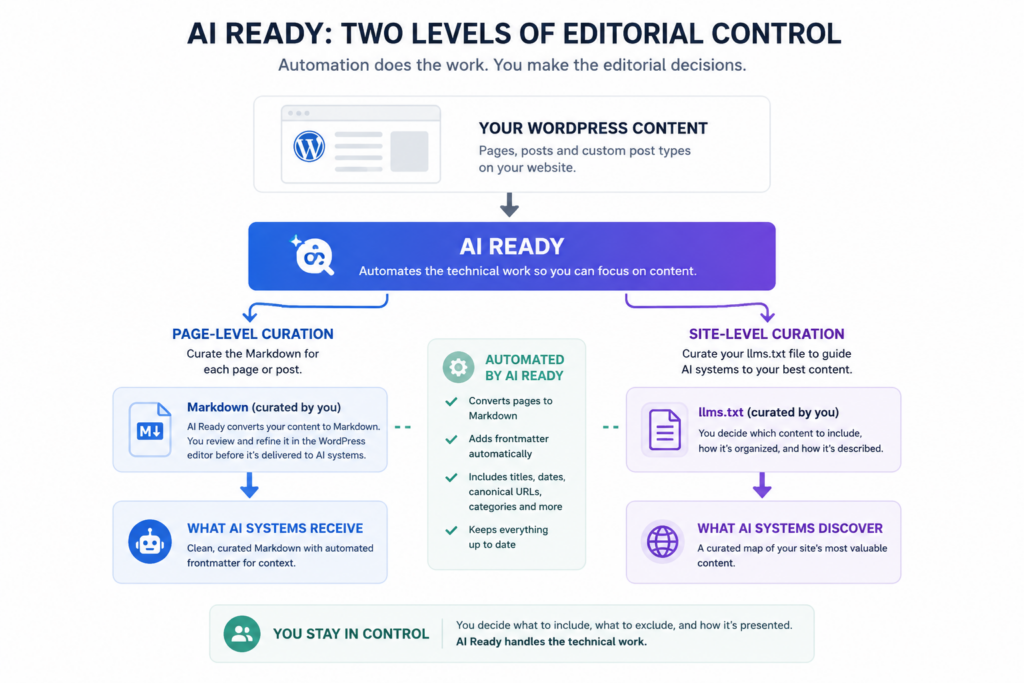
AI Ready is a WordPress plugin built specifically for GEO-focused AI discovery optimization.
Instead of automatically exporting every URL, the plugin emphasizes:
- content curation,
- semantic organization,
- and AI-focused prioritization.
The plugin is designed to help WordPress publishers control how their sites are presented to AI retrieval systems.
According to the implementation guide at how to use the AI Ready WordPress plugin, the goal is not simply generating a file—it’s building a curated AI-readable content layer.
Key features of AI Ready
Curated content selection
The plugin allows site owners to:
- prioritize cornerstone articles,
- feature evergreen resources,
- highlight authoritative guides,
- and exclude low-value pages.
This creates a cleaner retrieval environment for AI systems.
Semantic content organization
Content can be grouped into meaningful categories such as:
- Tutorials,
- Documentation,
- Guides,
- Research,
- FAQs,
- and Case Studies.
This semantic organization may help AI systems better understand topical relationships across a site.
Dynamic llms.txt management
Rather than manually editing static files, the plugin supports:
- ongoing updates,
- content synchronization,
- and evolving GEO maintenance workflows.
As your content library grows, your AI discovery layer evolves with it.
WordPress integration
The plugin also aligns naturally with:
- WordPress taxonomies,
- SEO plugins,
- sitemaps,
- and custom post types.
That makes it easier to integrate GEO into existing publishing workflows.
Best practices for using AI Ready
The implementation guide recommends focusing on quality over quantity.
Include high-value content
Prioritize:
- pillar pages,
- tutorials,
- documentation,
- service pages,
- and evergreen educational resources.
Avoid low-value URLs
Exclude:
- tag archives,
- thin content,
- duplicate URLs,
- search-result pages,
- and parameter-heavy pages.
Add human-readable context
Descriptions and summaries help AI systems interpret:
- topic focus,
- contextual meaning,
- and content relationships.
This may improve:
- retrieval quality,
- summarization accuracy,
- and citation relevance.
Treat GEO as an ongoing process
llms.txt should not be treated as a “set it and forget it” feature.
It works best when continuously curated alongside:
- content updates,
- technical SEO,
- schema optimization,
- and editorial strategy.
Example GEO-oriented llms.txt
The following example was taken from llmstxt.org:
# FastHTML

> FastHTML is a python library which brings together Starlette, Uvicorn, HTMX, and fastcore's `FT` "FastTags" into a library for creating server-rendered hypermedia applications.

Important notes:

- Although parts of its API are inspired by FastAPI, it is *not* compatible with FastAPI syntax and is not targeted at creating API services
- FastHTML is compatible with JS-native web components and any vanilla JS library, but not with React, Vue, or Svelte.

## Docs

- [FastHTML quick start](https://fastht.ml/docs/tutorials/quickstart_for_web_devs.html.md): A brief overview of many FastHTML features
- [HTMX reference](https://github.com/bigskysoftware/htmx/blob/master/www/content/reference.md): Brief description of all HTMX attributes, CSS classes, headers, events, extensions, js lib methods, and config options

## Examples

- [Todo list application](https://github.com/AnswerDotAI/fasthtml/blob/main/examples/adv_app.py): Detailed walk-thru of a complete CRUD app in FastHTML showing idiomatic use of FastHTML and HTMX patterns.

## Optional

- [Starlette full documentation](https://gist.githubusercontent.com/jph00/809e4a4808d4510be0e3dc9565e9cbd3/raw/9b717589ca44cedc8aaf00b2b8cacef922964c0f/starlette-sml.md): A subset of the Starlette documentation useful for FastHTML development.
This structure provides:
- semantic organization,
- topical clarity,
- and curated retrieval pathways.
Measuring GEO success
Traditional SEO metrics still matter:
- organic traffic,
- rankings,
- impressions,
- and CTR.
But GEO introduces new visibility signals.
Emerging GEO metrics
Publishers should begin tracking:
- AI referral traffic,
- chatbot citations,
- branded search growth,
- AI-generated mentions,
- and conversational discovery patterns.
Server logs and analytics platforms may increasingly reveal how AI systems interact with content.
The future of GEO and WordPress
The GEO ecosystem is still evolving rapidly.
Over the next few years we will likely see:
- AI-native WordPress plugins,
- retrieval analytics dashboards,
- semantic optimization scoring,
- citation tracking tools,
- and deeper AI crawler integrations.
WordPress publishers who prepare early will have a major advantage.
Sites that:
- build topical authority,
- structure content clearly,
- implement schema,
- curate AI discovery layers,
- and maintain strong technical SEO
will likely become preferred sources in AI-generated search experiences.
Final thoughts
Generative Engine Optimization is becoming a foundational layer of modern digital publishing.
As AI systems increasingly mediate information discovery, websites must evolve from simply being “search optimized” to being:
- machine-readable,
- semantically structured,
- retrieval-friendly,
- and citation-ready.
WordPress remains one of the best platforms for adapting to this shift.
And emerging tools like the AI Ready WordPress plugin offer publishers a practical way to begin building curated AI discovery systems today.
The future of search is no longer just about rankings.
It’s about becoming a trusted source for the machines generating the answers.