This checklist focuses on the technical implementation of a website to maximize its usefulness to AI search engines, AI assistants, and LLM-powered retrieval systems. Unlike traditional SEO, the emphasis is on making information easily discoverable, understandable, and quotable. In other words AI readyness.
1. Crawlability
□ Allow AI crawlers access
- Verify
robots.txtdoes not unintentionally block AI crawlers. - Review crawler-specific directives.
- Test accessibility from outside your network.
Verify
- □ robots.txt returns HTTP 200
- □ No accidental Disallow rules
- □ Important content is crawlable
□ Publish an llms.txt file
An llms.txt file should provide a curated table of contents of the site’s most valuable information.
Verify:
- □ Exists at
/llms.txt - □ Valid Markdown
- □ Contains concise summaries
- □ Links to canonical URLs
- □ Updated regularly
- □ Human curated
□ (Optional) Publish llms-full.txt
If appropriate:
- □ Long-form documentation
- □ API references
- □ Product manuals
- □ Knowledge base articles
2. Information Architecture
□ Create topic clusters
Avoid isolated pages.
Instead create:
Product
 ├── Features
 ├── Documentation
 ├── FAQ
 ├── Tutorials
 ├── Examples
 └── API
Verify:
- □ Every important page links to related pages
- □ Hub pages exist
- □ Deep pages are discoverable
□ Maintain shallow click depth
Important information should ideally be within:
- 3 clicks from homepage
Verify:
- □ No orphan pages
- □ Breadcrumbs enabled
- □ HTML navigation available
3. Structured Content
□ Use semantic HTML
Prefer
<h1>
<h2>
<h3>

<article>

<section>

<nav>

<aside>

<table>
Avoid excessive div nesting.
□ Use descriptive headings
Good
## WordPress REST API Authentication

## Pricing Plans

## Installation
Poor
## More

## Information

## Details
□ One topic per page
Each page should answer one major question.
Avoid:
- mixed subjects
- multiple unrelated products
- scattered documentation
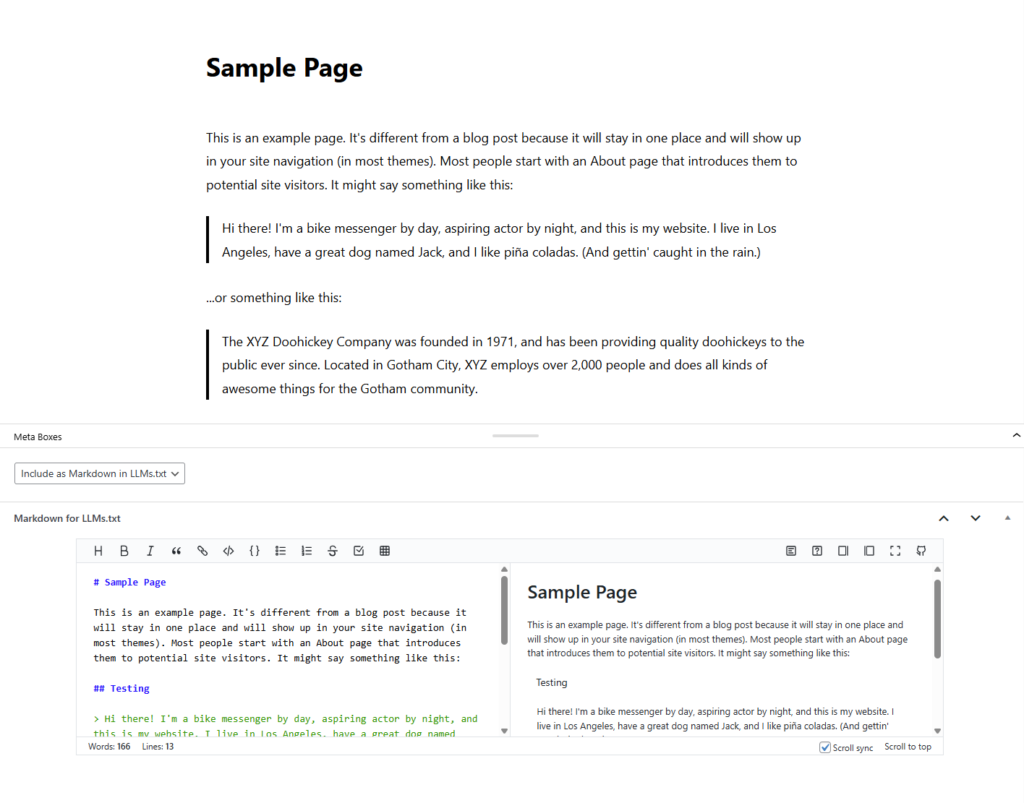
4. Markdown Availability
LLMs consistently perform well with Markdown.
Verify:
- □ Markdown version exists
- □ rel=”alternate” links provided
- □ Clean heading hierarchy
- □ Lists preserved
- □ Tables preserved
- □ Code blocks preserved
5. Metadata
□ Unique page titles
Avoid duplicates.
□ Useful meta descriptions
Not for rankings—
For summarization.
□ Canonical URLs
Every page should specify:
<link rel="canonical">□ Open Graph
Provide
- title
- description
- image
Many AI systems ingest Open Graph metadata.
6. Content Quality
□ Answer questions directly
Start pages with:
- definition
- explanation
- answer
Avoid long introductions.
□ Include definitions
Every important concept should have a concise definition.
Example:
Generative Engine Optimization (GEO) is the practice of structuring and curating web content so AI systems can accurately discover, understand, and cite it.
□ Use factual language
Avoid unnecessary marketing language.
Prefer
- specifications
- examples
- documentation
- facts
□ Include examples
Good pages contain:
- examples
- screenshots
- code
- tables
- comparisons
7. Authority Signals
□ Show authorship
Include:
- author
- organization
- publication date
- update date
□ Cite sources
Whenever possible:
- standards
- specifications
- research
- documentation
□ Maintain current information
Review pages regularly.
Outdated technical content reduces trust.
8. Internal Linking
Verify:
- □ Contextual links
- □ Related articles
- □ Documentation references
- □ Product links
- □ FAQ links
Avoid orphan pages.
9. Performance
□ Fast page load
Target
- Core Web Vitals
- HTTP/2 or HTTP/3
- Compression
- CDN
□ Minimize JavaScript dependency
Critical content should exist in HTML.
Avoid requiring JavaScript to render primary content.
10. Machine Readability
□ Clean HTML
Avoid
- malformed markup
- duplicate IDs
- deeply nested DOM
□ Consistent URL structure
Example
/docs/
/docs/install/
/docs/api/
/docs/tutorials/
□ Stable URLs
Avoid changing URLs unnecessarily.
Maintain redirects.
11. Images
Verify:
- □ Descriptive alt text
- □ Captions
- □ Relevant filenames
Example
wordpress-llms-plugin-settings.pnginstead of
IMG_23884.png12. Documentation
Technical documentation should include:
- □ Introduction
- □ Requirements
- □ Installation
- □ Configuration
- □ Examples
- □ Troubleshooting
- □ FAQ
13. APIs
If applicable:
- □ Endpoint documentation
- □ Authentication
- □ Examples
- □ Error codes
- □ Rate limits
14. Freshness
Review:
- documentation
- pricing
- screenshots
- examples
- API references
Outdated examples are frequently surfaced by LLMs.
15. AI-Friendly Formatting
Prefer:
- Short paragraphs
- Bullet lists
- Numbered steps
- Comparison tables
- Clear headings
- FAQ sections
Avoid:
- Walls of text
- Multiple concepts per paragraph
16. Schema Markup
Implement structured data where appropriate:
- □ Organization
- □ Article
- □ FAQPage
- □ Product
- □ SoftwareApplication
- □ BreadcrumbList
- □ HowTo
- □ WebPage
Validate with schema testing tools.
17. Security
Verify:
- □ HTTPS everywhere
- □ No mixed content
- □ Valid certificates
- □ Secure redirects
18. Monitoring
Track:
- AI crawler visits
- Referral traffic from AI platforms
- llms.txt requests
- Markdown requests
- Crawl errors
- 404s
- Server logs
Monitor user agents from platforms such as ChatGPT, Claude, Gemini, Perplexity, and other AI services to understand how they access your content.
19. WordPress-Specific GEO
For WordPress sites:
- □ Generate a curated
llms.txtfile - □ Create Markdown versions of important content
- □ Expose Markdown using
rel="alternate"where available - □ Keep XML sitemaps current
- □ Use descriptive permalinks
- □ Eliminate thin archive pages where appropriate
- □ Maintain accurate categories and tags
- □ Optimize media metadata (alt text, captions, filenames)
- □ Ensure custom post types intended for AI discovery are publicly accessible
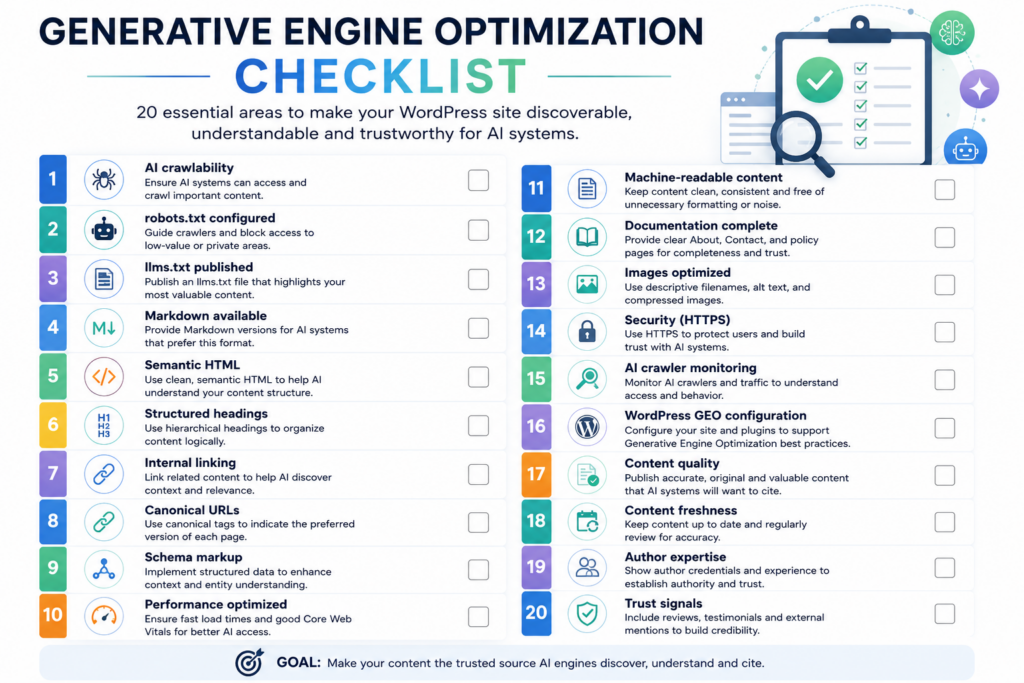
20. GEO Audit Scorecard
| Category | Status |
|---|---|
| AI crawlability | ☐ |
| robots.txt configured | ☐ |
| llms.txt published | ☐ |
| Markdown available | ☐ |
| Semantic HTML | ☐ |
| Structured headings | ☐ |
| Internal linking | ☐ |
| Canonical URLs | ☐ |
| Schema markup | ☐ |
| Performance optimized | ☐ |
| Machine-readable content | ☐ |
| Documentation complete | ☐ |
| Images optimized | ☐ |
| Security (HTTPS) | ☐ |
| AI crawler monitoring | ☐ |
| WordPress GEO configuration | ☐ |
Goal
The goal of technical GEO is not simply to make pages crawlable, but to make them easy for AI systems to parse, understand, retrieve, and accurately cite. A technically optimized site combines strong information architecture, machine-readable formatting, curated discovery resources such as llms.txt, and high-quality, well-maintained content to improve its visibility in AI-powered search and answer generation.
Generative Engine Optimization (GEO) for WordPress: Essential Hacks to Improve AI Citation